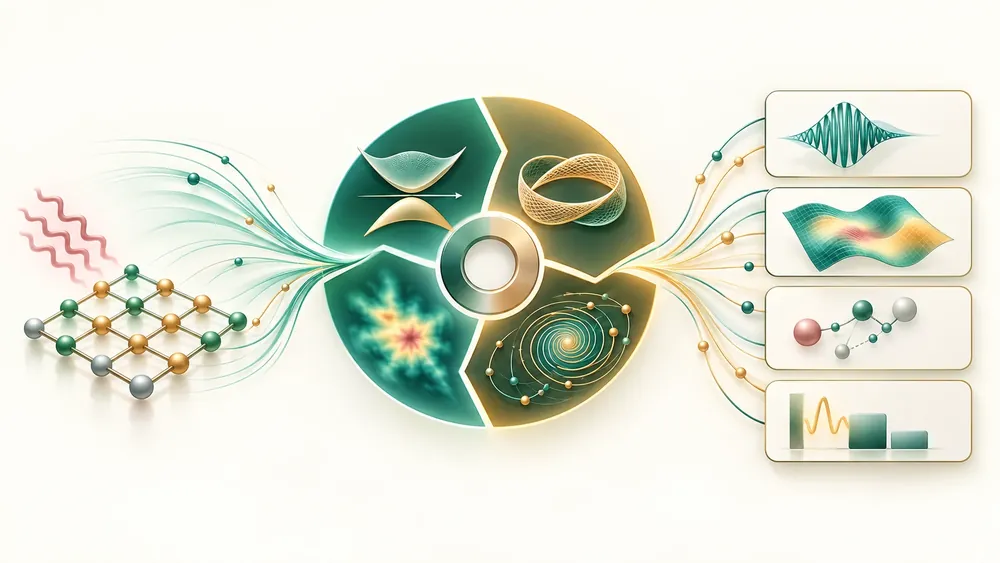
Discover physics in data. Explore intelligence in physics.
Two connected questions guide our work: how can data and learning help us understand complex physical systems? And how can physical structure help us understand and build learning systems?
AI → SCIENCE
AI for Science
Make complex dynamics readable.
SCIENCE → AI
Science for AI
Make learning mechanisms understandable.
01 / KOOPMAN–DMDPublic preprint
Turn evolving data into interpretable modes.
A movie of a wave often contains several rhythms at once. The Koopman operator perspective and dynamic mode decomposition (DMD) help separate modes from successive snapshots, revealing their frequencies, growth or decay, and spatial profiles.
Let the physical picture emerge.
Hover to preview. Click to keep. Explore until the picture is complete.
Koopman–DMD
Extract frequencies, growth or decay, spatial profiles and weights to make dynamics readable.
Dynamics → Modes → Physical insight
FIG. 01A Koopman–DMD research landscape · Conceptual illustrationLabelled figure ↗
What can a sequence of data reveal?
Select a quantity to see what each mode tells us.
Snapshots→Koopman–DMD→Modal information
How fast does it oscillate?
A signal can combine slow and fast oscillations. Modal frequencies separate these rhythms and help connect dynamics to band dispersion.
FIG. 02An illustration of modal concepts, not paper data. DMD approximates dynamical structure from snapshots; it is not the same as training a neural network.
02 / PINED-NETOngoing research
Build a physical network with light and electrons.
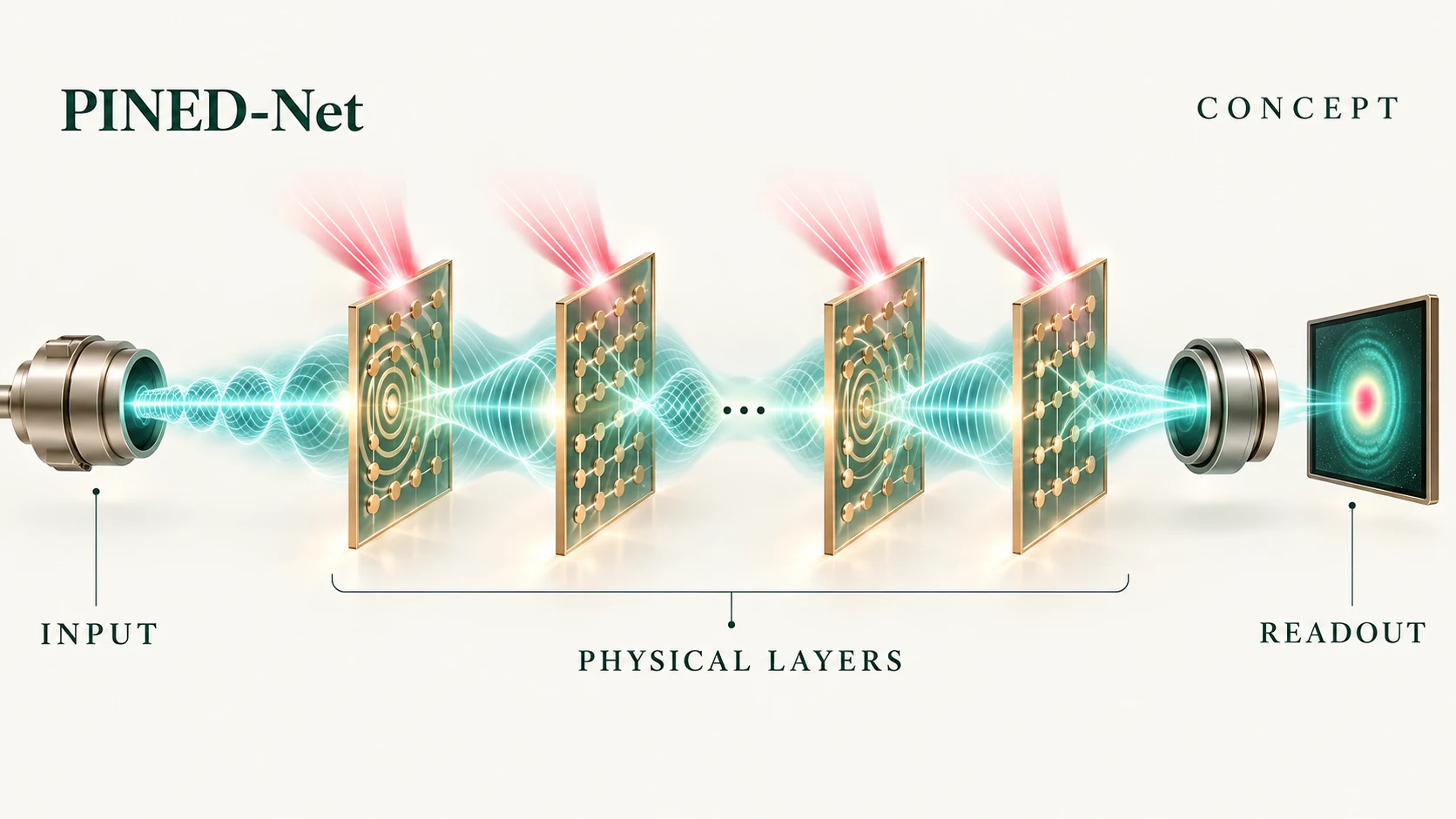
Could neural-network computation take place in real wave propagation? PINED-Net explores photon-induced near-field electron interactions: light shapes an electron wave, information passes through successive physical layers, and the output is read out.
FIG. 03Simplified PINED-Net concept. Layer count, wave propagation and the output spot are illustrative.
01
Input information
Bring information into an electron wave.
02
Light-driven physical layers
Light–electron interactions shape the wave state across layers.
03
Propagation & readout
Turn the output of successive physical processes into readable information.
This is ongoing research. We present the basic idea here; implementation details and results will be described in future work.
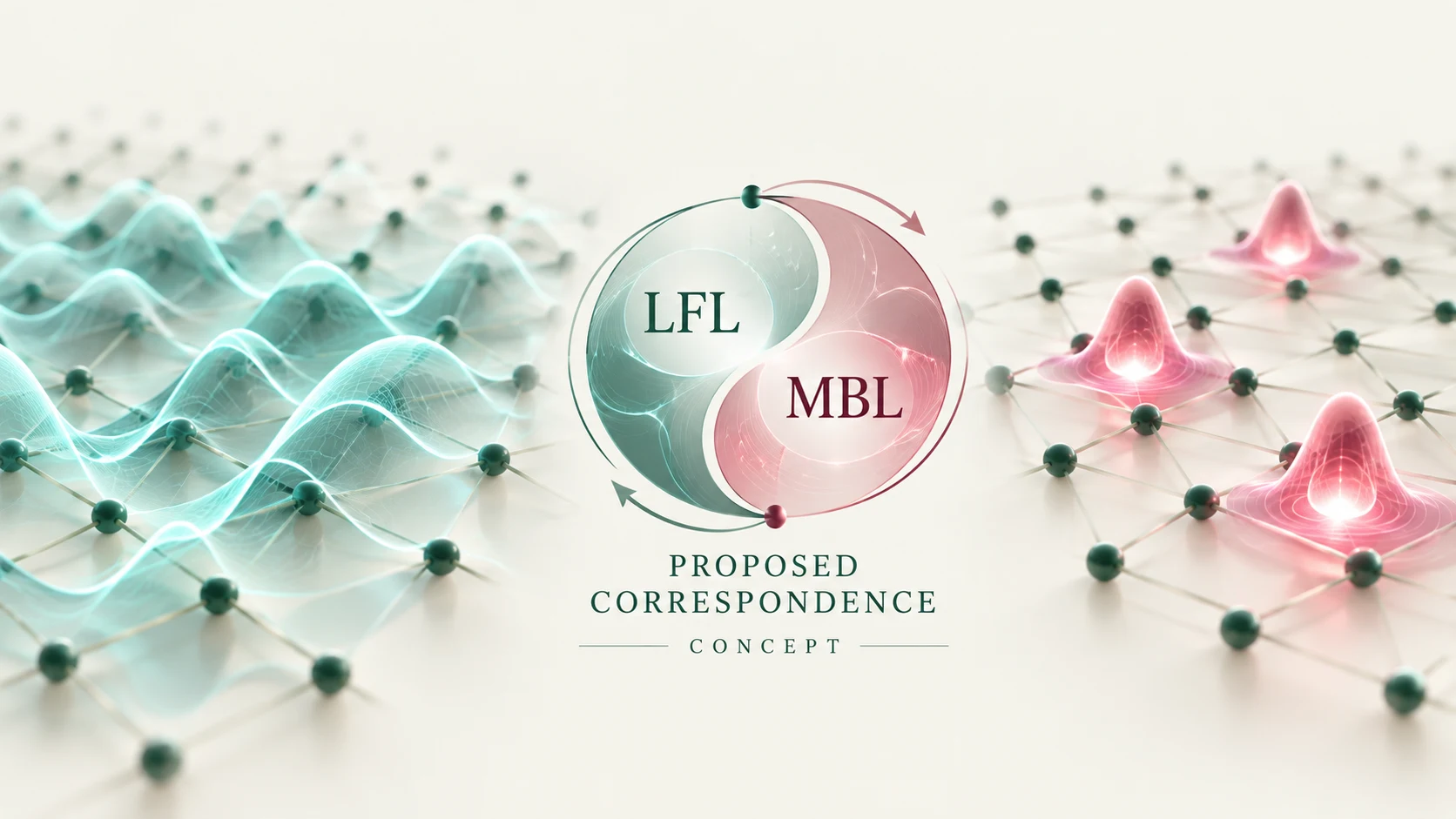
Topology asks how global structure shapes wave behavior. Localization asks how waves remain confined. We aim to connect these physical questions with dynamical features in data.
FIG. 04Redrawn from Pan, He and Pan, J. Phys.: Condens. Matter 38, 075702 (2026), Fig. 4 (original CC BY 4.0). A conceptual illustration of a phenomenological correspondence.
Physical foundation · Many-body localization and Fermi liquids
In work co-first-authored by Jinze He, we propose a phenomenological correspondence between extended Fermi-liquid quasiparticles and local integrals of motion in many-body localization, and discuss normal-state instabilities. This offers physical clues for comparing many-body states and their observable features.
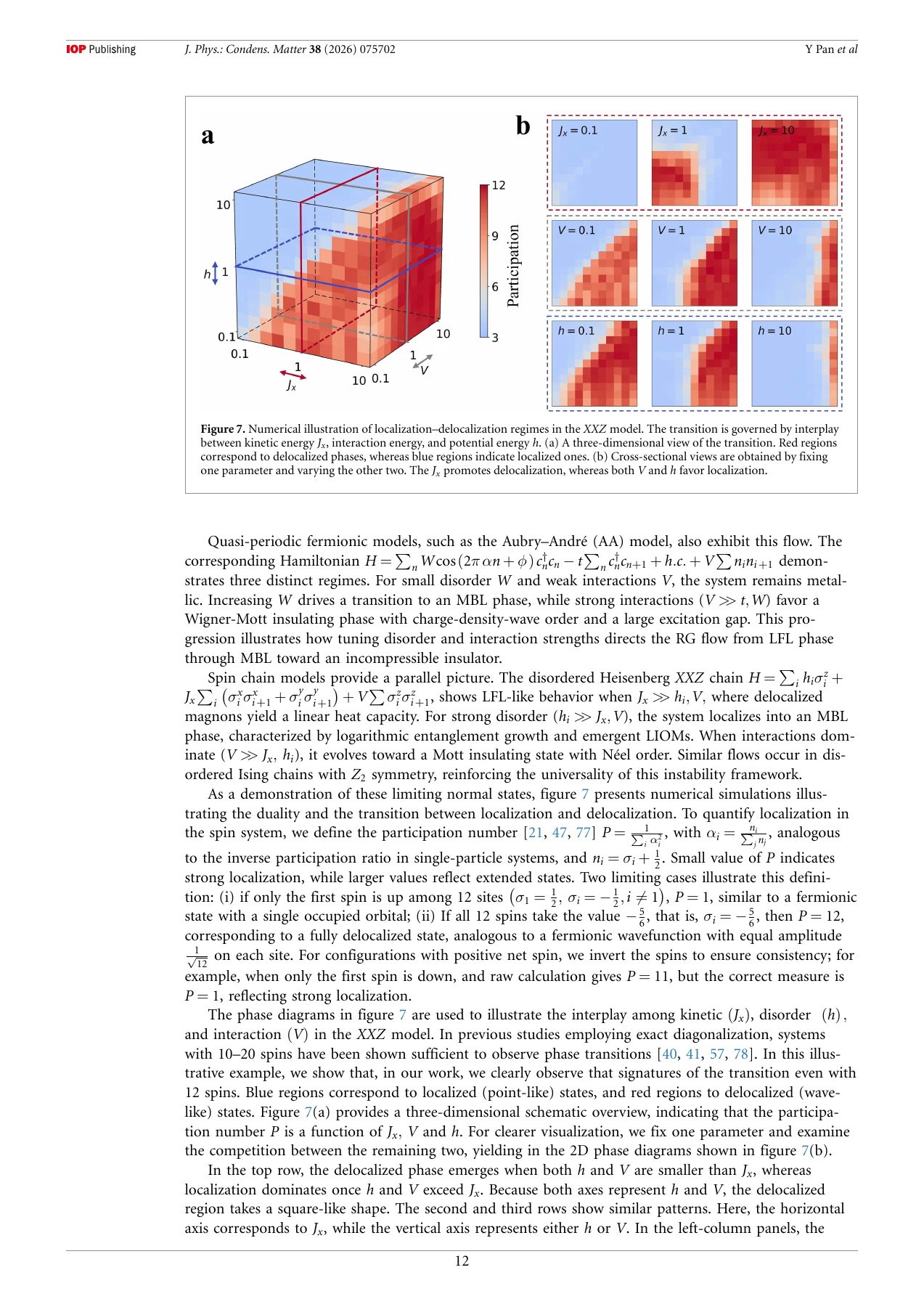
Figure 7 illustrates a 12-spin XXZ system and the competition among kinetic energy, disorder and interactions. This finite-size example is not a rigorous phase-boundary determination in the thermodynamic limit.
04 / SCIENCE FOR AI
What does a neural operator actually learn?
Predicting the next frame is a starting point. We also ask how a network uses physical information, whether its learned structure can be explained, and whether physical operators and wave propagation can become trainable information processors.
Public preprint
MH-RG DeepONet · Bringing physical information into learning
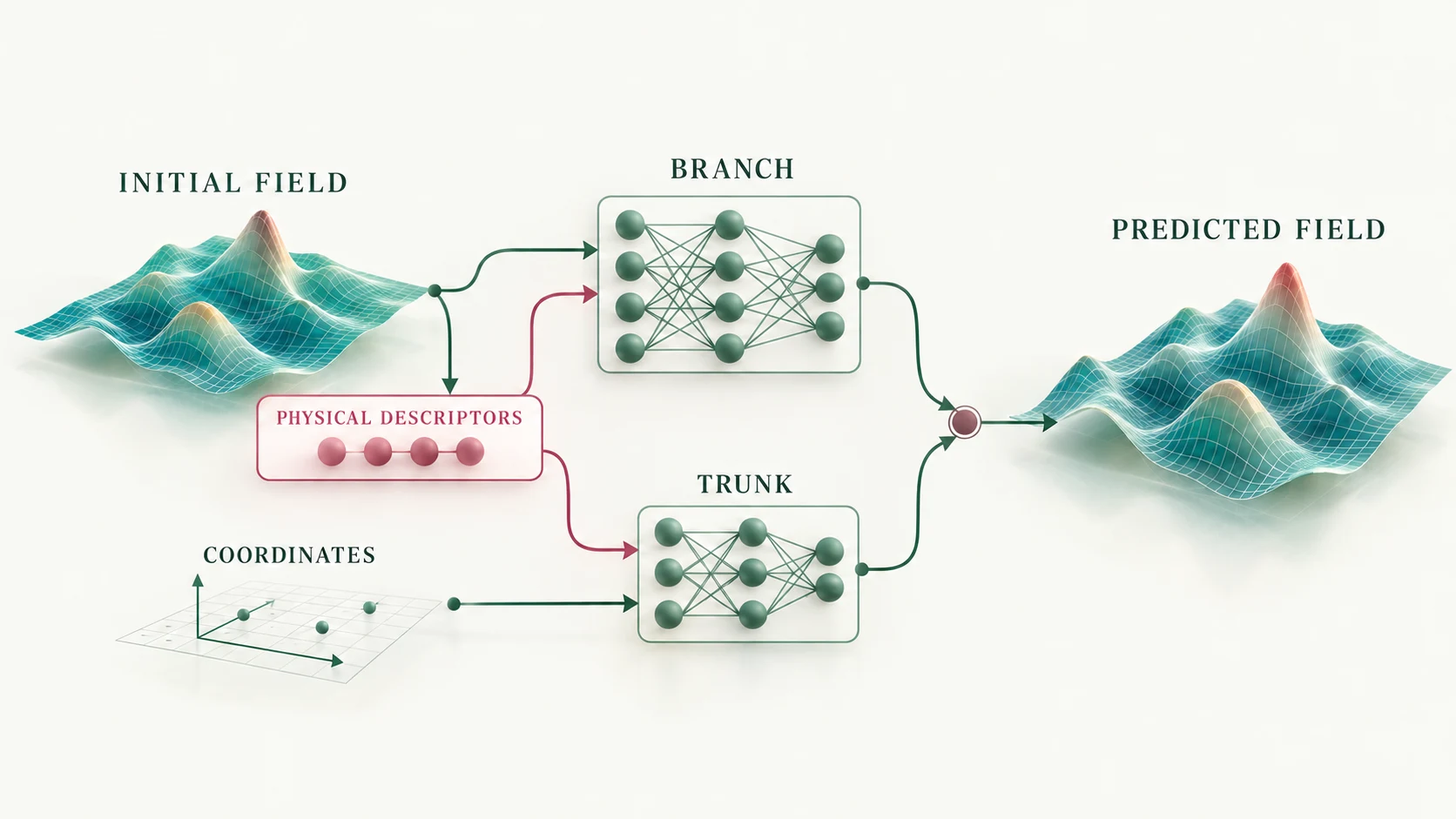
A neural operator learns a mapping between functions. Here, the initial field and coordinates enter branch and trunk networks. Physical descriptors inform both representations before they are combined to predict field evolution. The multi-head structure offers a way to investigate model behavior.
FIG. 05Redrawn from the public MH-RG DeepONet architecture. Waveforms are illustrative and do not represent errors or performance.Explore the model-analysis figures
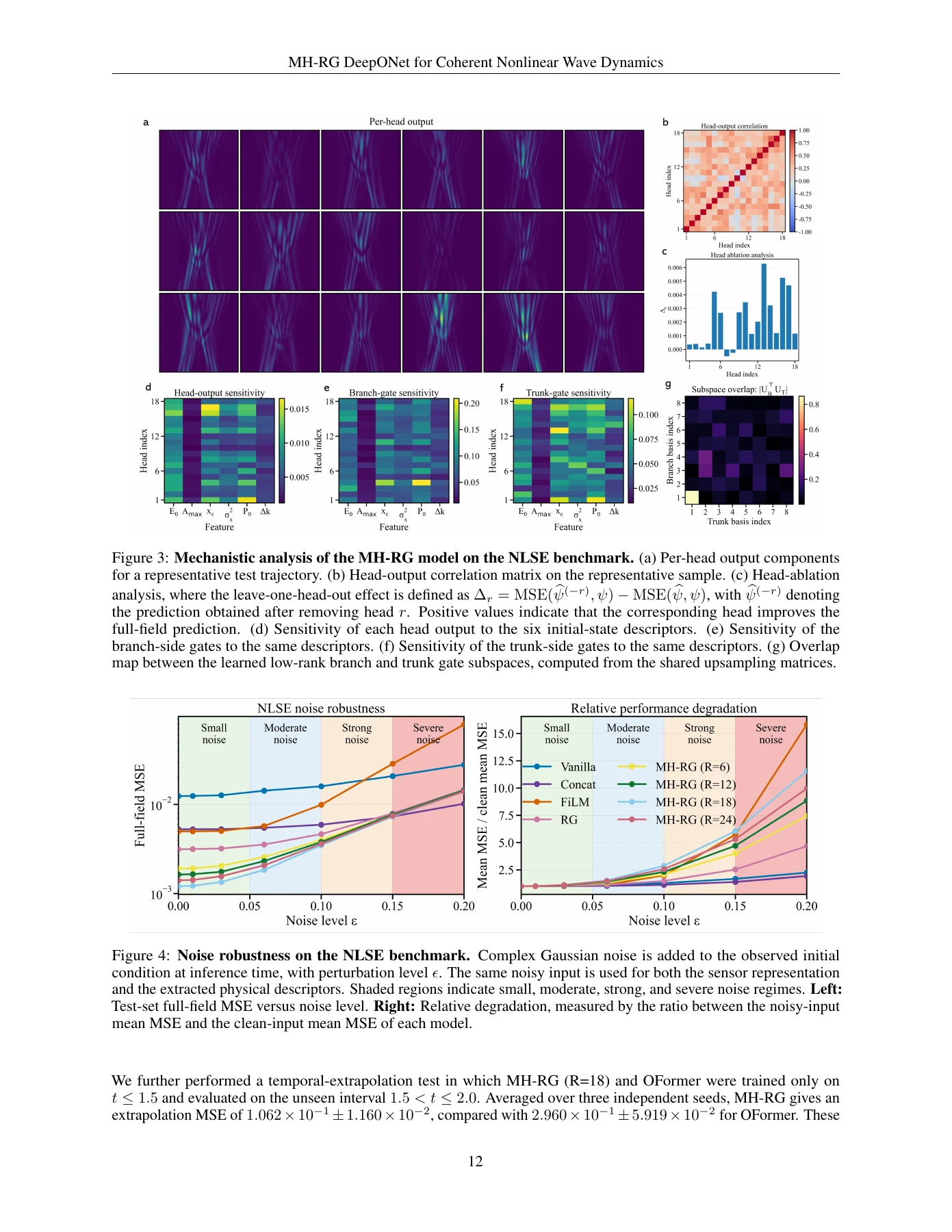
Multi-head mechanism analysis and noise tests from the public paper (Figs. 3 and 4). Reliability should be assessed together with test conditions and measured errors.
Questions we are pursuing
How does physics help learning?
Physical descriptors can bring relevant structure into a model. We ask when they improve prediction or generalization, and which information actually matters.
How can we understand neural operators?
Can modes, symmetries and multiple scales explain how a model organizes information? Interpretability needs controlled comparisons and testable mechanisms, beyond visualization alone.
Can physical operators be intelligent?
If intelligence means trainable, adaptive information processing, what computations can waves and physical interactions perform? PINED-Net explores this possibility; the broader question remains open.