Ultrafast, strong-field & free-electron quantum optics
Laser-driven free-electron acceleration (DLA) and free-electron radiation (FEL)
Photon-induced near-field electron microscopy (PINEM)
Attosecond control and quantum weak measurement
Quantum, quantum, and more damn quantum! Strong fields, strong fields, and more damn strong fields!
We study interactions between free electrons and light in strong-field and quantum regimes. Our applied-physics goal is controlled transfer of energy, momentum and information between electrons and optical fields; our fundamental goal is to explore the deeper structure of electromagnetic interactions.
Laser-driven free-electron acceleration (DLA) and free-electron radiation (FEL)
Photon-induced near-field electron microscopy (PINEM)
Attosecond control and quantum weak measurement
Topological photonics in laser-written, plasmonic and microwave waveguides.
Synthetic dimensions for ultrafast PINEM electrons. Topological Floquet time crystals and nonlinear photonic time crystals.
Time-modulated momentum-gap solitons, subharmonic generation and nonlinear modulation instability.
Chiral transport in Weyl semimetals, quantum transport in two-dimensional materials, and optical responses of Weyl semimetals.
Quantum anomalies and the Callan–Harvey mechanism in periodically driven systems.
Free-electron quantum optics (QFEL, DLA, UTEM), material-free condensed-matter physics, photonic spacetime crystals, quantum anomalies, optical solitons, duality, quantum weak measurement, neural operators and Koopman operators (AI4Science).
We are interested in electrons and light themselves; materials provide the phase matching and field enhancement.
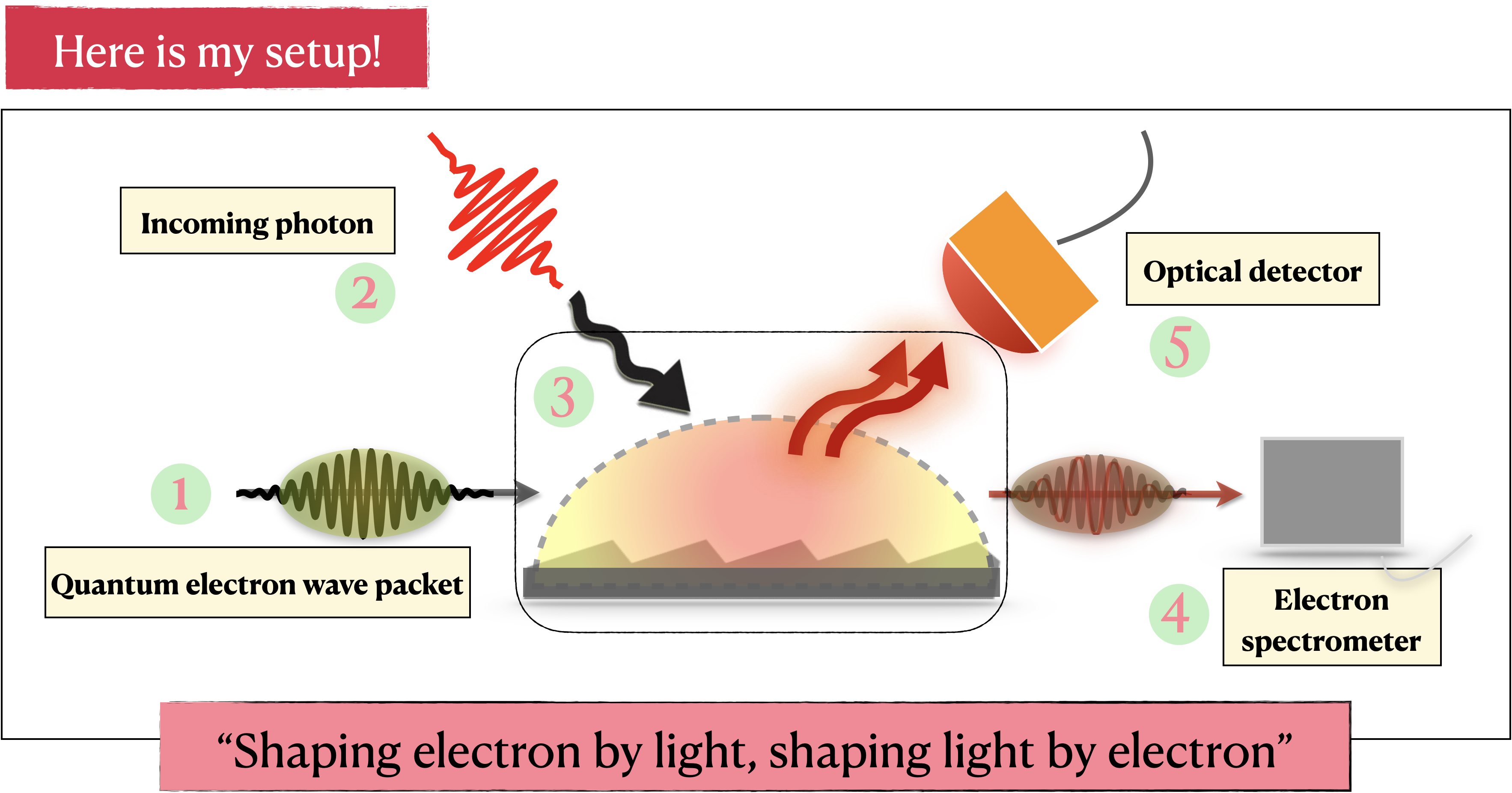
“Shaping electron with light,— Ido Kaminer · Technion
shaping light with electron.”
‘Pan, could light simply be electricity, and electricity simply light?’ — Zhaopin Chen · Technion
An electron is more than a charged particle: it is a quantum wave that light can sculpt. We study ultrafast electrons interacting with near-field light, using electron energy sidebands as synthetic dimensions to explore acceleration, wavefunction reconstruction, interference and quantum-state control.
From PINEM and dielectric laser acceleration to ultrafast electron microscopy, theory and experiment address a shared question: how can we control and read out the energy, momentum and quantum information exchanged by light and free electrons?
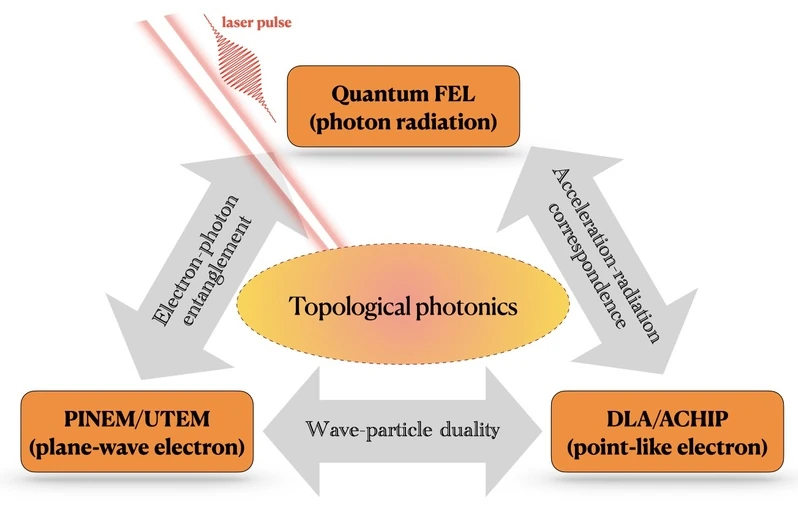
[Rep. Prog. Phys. 88 017601(2025); PRL 132, 3 (2024): 035001; Light Science & Applications 12:267 (2023); Science Advances 9, eadg8516(2023); PRL 126, 137403 (2021); PRL122.183204 (2019).]
Spatial periodicity reshapes energy bands; temporal periodicity opens momentum gaps. We study how spacetime modulation, nonlinearity and topology shape optical fields, from balancing gain and decay to localized wavepackets and quantum correlations.
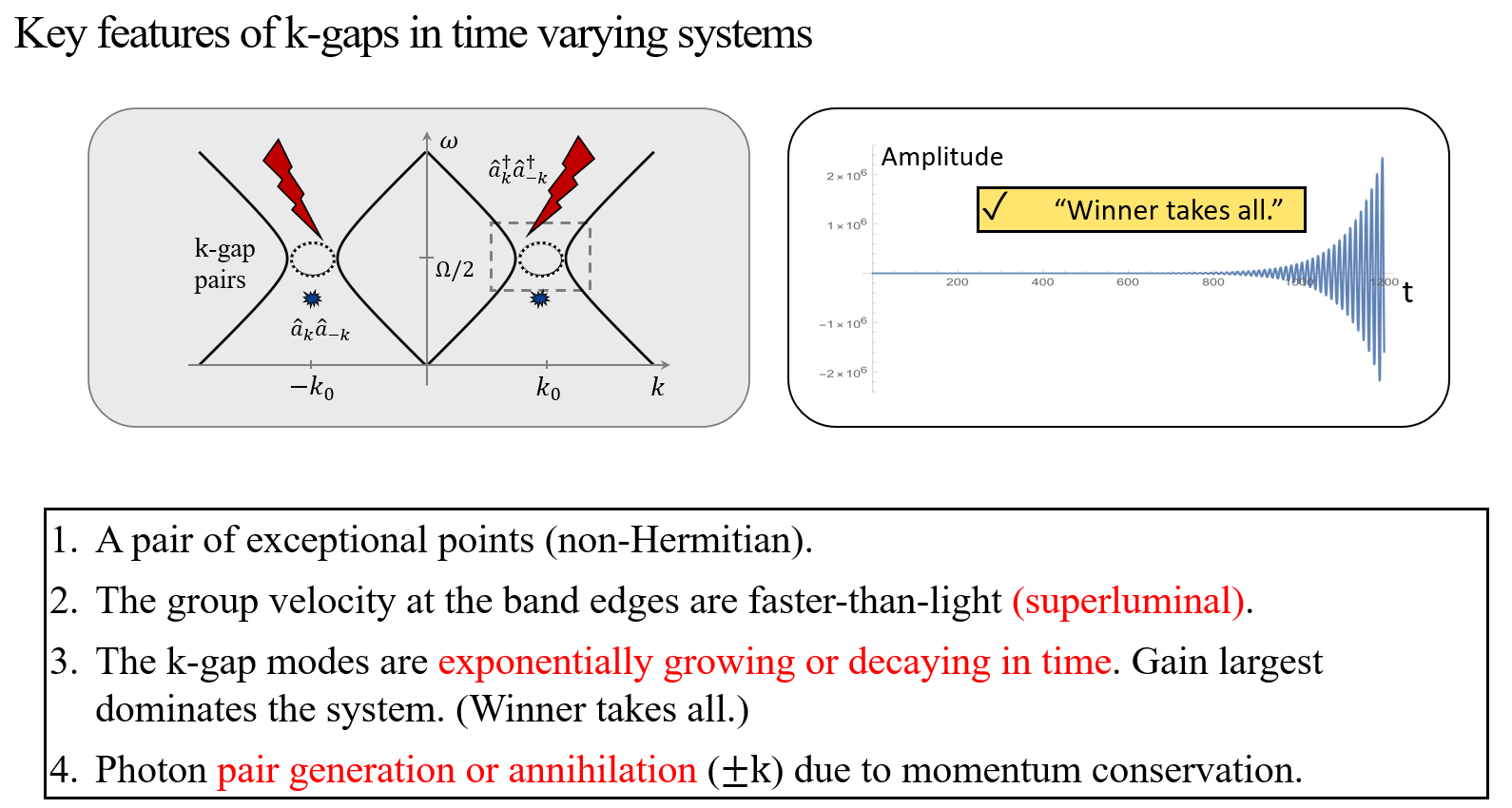
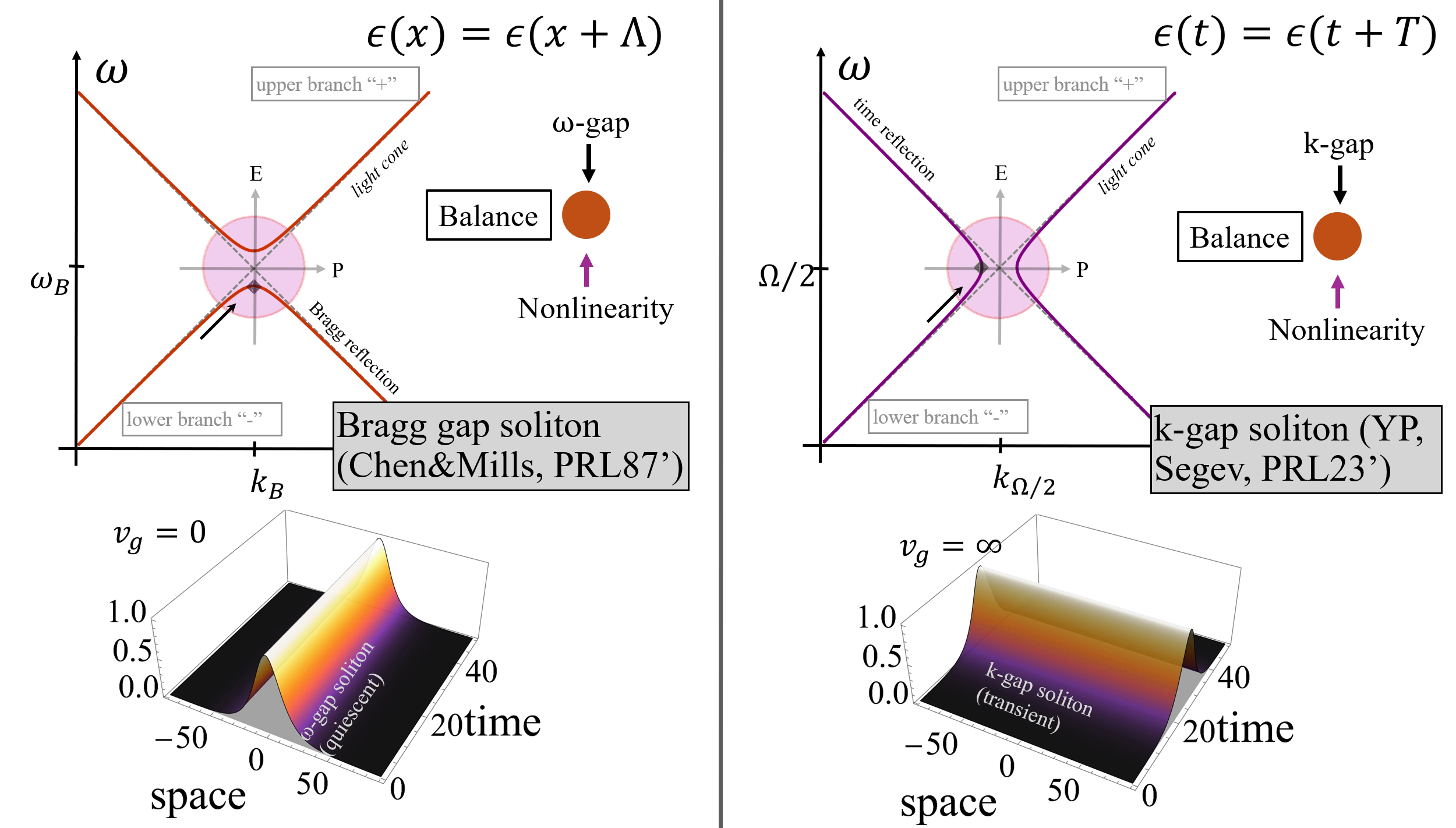
We study Bloch oscillations and interband interference in k-gap lattices, self-balancing dynamics, and the influence of momentum-gap amplification on solid-state high-harmonic generation.
We investigate event solitons and topological event wavepackets in mixed energy–momentum gaps, exploring nonlinear localization, topological protection and phase-controlled pair annihilation.
We further explore breathing k-gap events, soliton quantization and biphoton statistics, and Stokes pair formation in finite time crystals. The following studies are currently available as preprints.
• Ultrafast electron generation and manipulation, and strong-field electron photon coupling at discontinuity.
• Design an ultrafast photoelectron gun and realize multi-photon free-free transition for low-energy free electrons.
• Floquet quantum simulators: optics, microwave, sounds, atoms and free electrons.
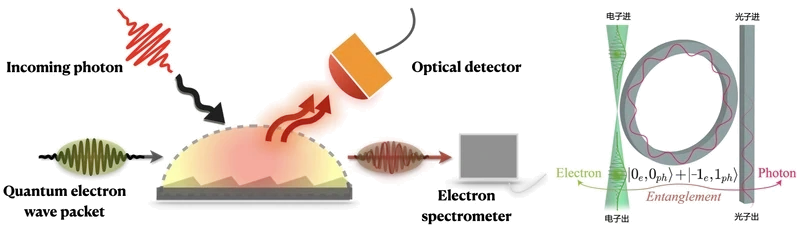
Scientific principle:
In a nutshell: create and detect quantum entanglement between ultrafast electrons and photons!
Fundamental science and potential applications:
First, combine optical and direct electron detectors for time-correlated coincidence measurements of free-electron–photon entanglement. After building the platform, optimize and upgrade it toward a broadly usable ultrafast electron quantum microscope.
We are developing a free-electron quantum-optics laboratory, an ultrafast optics platform, superconducting single-photon detection and subsystems for ultrafast transmission electron microscopy, connecting theoretical predictions with experimental tests.